
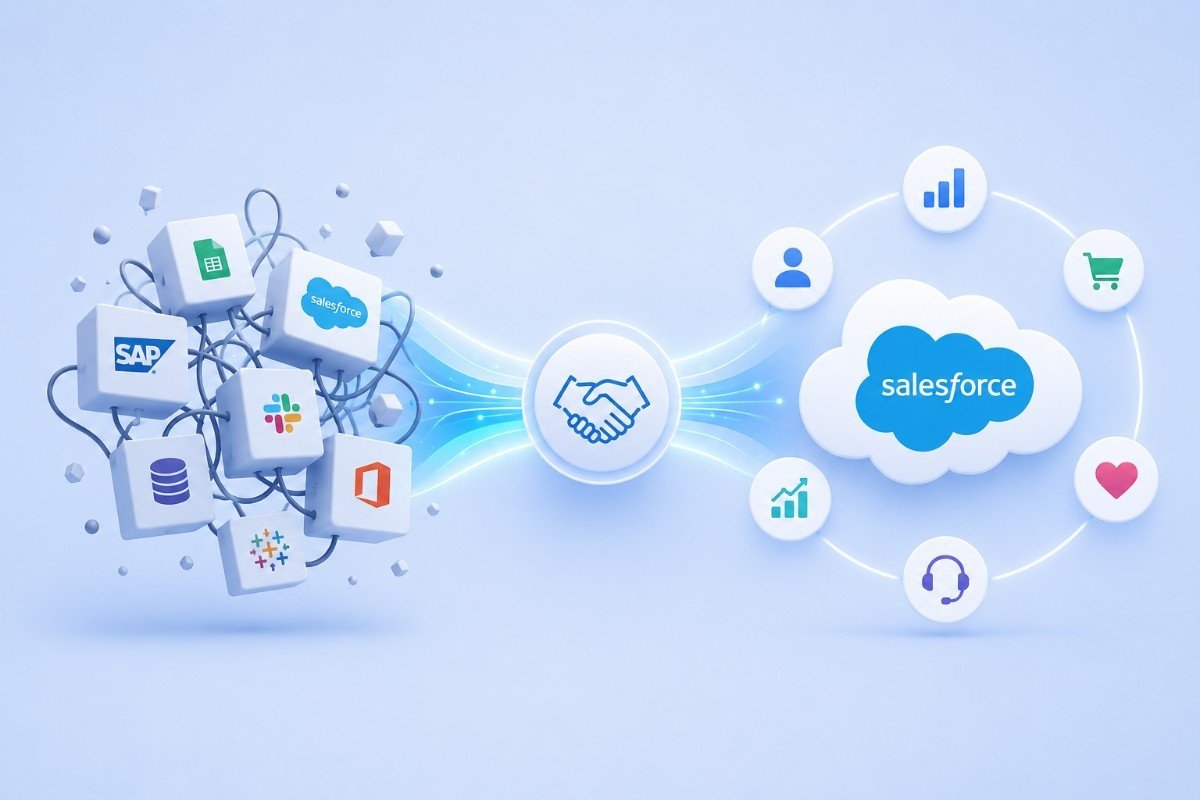
How Salesforce Integration Partners Reduce Enterprise Sprawl
Your agents are moving faster than your controls can keep up. That's not a complaint about speed — it's a warning about risk.
Organizations are deploying AI agents across sales, service, finance, and operations at rates that would have seemed impossible two years ago. But speed without guardrails creates sprawl: isolated agents working without knowledge of each other, permission conflicts, data governance gaps, and compliance gaps that no one catches until something breaks. This is where Salesforce integration partners become essential architects of control.
The best way to manage agentic sprawl is before it starts. The difference between companies thriving in the agentic era and those struggling with governance failures is simple: one group works with a Salesforce registered partner to design governance as a first-class system, not a cleanup operation.
The Cost of Unplanned Agent Sprawl
Fifty percent of enterprises today are running agents in isolated silos. This isn't because leaders chose sprawl — it happened because pilot projects became production systems before anyone asked the hard questions. What permissions does this agent have? Where does it source its data? What happens if two agents trigger the same workflow simultaneously?
The result is evident. Organizations with disconnected agent systems report lower confidence in agent reliability, higher operational risk, and teams spending cycles on manual oversight instead of strategic work. Governance built after deployment is always more expensive than governance built before it.
Skilled Salesforce integration partners understand this. They don't wait for sprawl to happen. They design against it from day one — mapping data flows, defining agent responsibilities, and encoding compliance into the agent itself, not bolting it on after deployment.
What Governance as Architecture Actually Looks Like
Governance in the agentic enterprise isn't a checklist of compliance tasks. It's a design decision that touches data, permissions, orchestration, and monitoring before a single line of agent logic is written. The best Salesforce integration consultants structure this work around four core pillars.
1. Data Governance: Agents Need a Single Source of Truth
Most organizations run agents against fragmented data. Your sales agent pulls from the CRM. Your service agent uses a separate knowledge base. Your finance agent has a data warehouse. Each system has slightly different versions of the customer record, and the agents have no way to reconcile the differences. This creates contradictions, stale data, and agent decisions based on incomplete information.
The best Salesforce integration services providers solve this by putting Data 360 at the center. This unified data layer becomes the agent's single source of truth. Every agent references it. Every data quality issue is visible in one place. Every permission applies consistently across all agents that touch that data. This eliminates the conflicts that transform sprawl into agent failure.
2. Permission Architecture: Control Without Creating Bottlenecks
An agent with too few permissions becomes a useless automaton. An agent with too many becomes a business liability. The trick is defining permissions that match the agent's actual responsibility — no more, no less.
Partners who specialize in Salesforce integration services approach this systematically. They map the agent's workflow first. Then they ask: what data must this agent read? What actions must it execute? What decisions require human review? The answers become the permission boundary. This work happens in design reviews, not in production firefighting.
3. Orchestration and Coordination: Multiple Agents, One Story
Single agents are the easy part. Coordinating five agents that need to hand off to each other — that's where governance becomes critical. If two agents try to update the same record simultaneously, who wins? If one agent's decision conflicts with another's, how does the system recover? These aren't edge cases. They're inevitable once agent count reaches scale.
A Salesforce registered partner with deep integration expertise uses API-driven architectures to orchestrate agents. This means defining clear handoff points, using event-based triggers to keep agents in sync, and building observability that shows exactly which agent made which decision and why. This level of coordination prevents the chaos that emerges when agents operate in isolation.
4. Monitoring and Observability: Catching Problems Before Customers Do
Governance without observability is ineffective. You can't enforce rules you can't see being broken. The moment an agent starts making incorrect decisions, approving the wrong customers, or accessing data it shouldn't — you need to know immediately, not three days later when a customer complains.
Salesforce integration experts build monitoring frameworks that go beyond dashboards. They establish real-time alerts for policy violations. They set up audit trails that show what every agent accessed and when. They create feedback loops so that when an agent makes an incorrect decision, the system learns from it and prevents similar errors. This transforms governance from something reactive into something anticipatory.
Why Governance Expertise Matters More Than Technology
You can buy the technology. Salesforce has an increasingly mature Agentforce platform. But technology alone doesn't prevent sprawl. Sprawl happens when you deploy agents without thinking through how they'll coexist with other agents, how they'll access data consistently, and how you'll control them once they're in production.
This is where Salesforce integration experts earn their role. They've seen the governance patterns that work and the shortcuts that fail. They know that setting up API management early prevents agent fragmentation later. They understand that agent design and governance design are inseparable. And they bring repeatable, battle-tested approaches to the decisions that most organizations have to figure out from scratch.
Three Critical Questions Your Partner Should Answer Before Day One
Before you deploy a single agent, your Salesforce integration partner should have clear answers to these questions.
First: How will your agents access data without creating silos? This is about designing a unified data layer from the start — not bolting it on when agents conflict. A strong integration partner has already designed this for companies in your industry. They know how to map legacy systems, set up Data 360 properly, and give agents consistent access to customer truth.
Second: What happens when an agent makes a decision humans need to understand? Governance isn't just about preventing agents from breaking things. It's about building transparency into their logic. When an agent approves a deal, declines a service request, or escalates an issue, there's a trail showing why. The best Salesforce integration consultants design this observability into agents from the start.
Third: How will you orchestrate handoffs between agents without creating conflict? Your sales agent closes a deal. It hands off to your finance agent to set up billing. Your finance agent triggers your legal agent to prepare contracts. If these agents aren't coordinated, you end up with contradictory actions or missing steps. Real governance is about orchestration — making sure agents work as a system, not as individuals.
From Pilot to Scale: How Integration Partners Enable Responsible Growth
The companies succeeding at agentic scale don't just deploy more agents. They deploy agents with confidence — because governance is built in, not bolted on later. That confidence comes from partners who know how to turn fragmented pilots into coordinated systems.
This is where finding a Salesforce partner becomes a strategic decision, not just a resource question. The right partner doesn't just build agents. They design the governance frameworks that allow you to scale agents safely, without creating the sprawl that derails other organizations.
If your organization is serious about moving beyond agent experimentation to sustainable, multi-agent operations, the partner you choose in 2026 will determine whether you move with speed or struggle with control. Find a Salesforce partner who understands that governance isn't overhead — it's architecture.
Conclusion
Agents are no longer experiments. They're operational infrastructure. Organizations that treat governance as an afterthought will hit a wall at scale. Those that treat it as foundational architecture — with help from Salesforce integration firms who've solved this problem before — will move from pilot success to enterprise-wide impact. When you're ready to scale responsibly, talk to a Salesforce integration expert who understands agentic governance. Your future sprawl problems are easier to prevent now than fix later.








0 Comments